

Resources
Resources for Classical Lutheran Education
The CCLE offers a wide variety of resources for classical Lutheran educators, administrators, and parents. Visit our Free Resources collection below to access videos, publications, audio, and find recommendations for curriculum, websites, classical organizations, and books. The School Resource Library is available to educators with a CCLE Institutional Membership. Our Blog shares perspectives from leading contributors to Classical Lutheran Education, and many articles are available in Spanish.
Starting a classical school? Converting your school to classical education? Contact the CCLE BEFORE talking with any paid consultant! The CCLE does not currently recommend—nor do we have a formal affiliation—with any external consulting businesses or services for classical Lutheran education. If you are looking for advice on how to start a classical Lutheran school, please contact our executive director. If you are looking for advice on how to prepare for school accreditation, please contact our director of accreditation.
Looking for information on the new Federal Scholarship Tax Credit? Visit our FSTC page, which is frequently updated with information for schools and families about the tax credit.
CCLE Resources
Content created by the Consortium for Classical Lutheran Education to assist classical Lutheran educators, administrators, and parents.
What is Classical Lutheran Education?
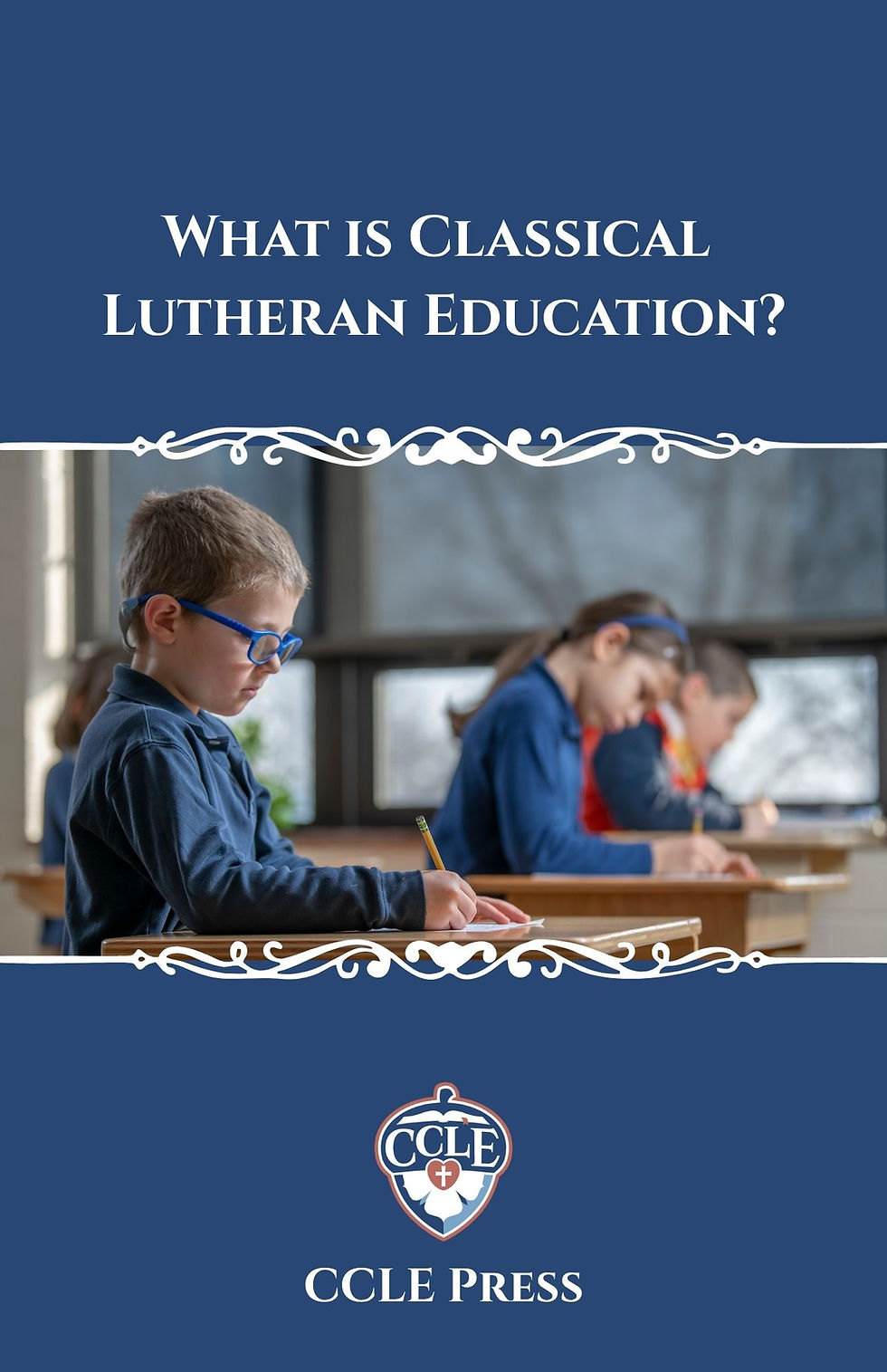
What is Classical Lutheran Education? (Third Edition) is a 20-page booklet that is a useful resource for schools to use in marketing, recruitment, and to educate existing families about the value and importance of classical Lutheran education. It contains talking points and summaries of the characteristics, methods, and benefits of classical Lutheran education, and also includes inspiring quotes and helpful data. Available in packs of 50, 100, 200, or 400 at a volume discount. The booklet can be customized with your school’s name and logo. If you choose the “Customized for your school” option, you will be contacted via email to gather the necessary information. Third Edition published: June, 2026, CCLE Press
Adopting Classical Lutheran Education—Second Edition

Adopting Classical Lutheran Education is a collection of resources, information, and practical advice that is designed to help Lutheran school teachers, administrators, and homeschool parents make the transition to classical education. It is also a useful tool for those already practicing classical Lutheran education in honing their craft. Included in this book are stories of schools that have successfully achieved the transition, so that others may benefit from their experiences. In the words of Rev. Dr. Thomas Korcok, “Adopting Classical Lutheran Education is an invaluable book for teachers, administrators, pastors, and parents seeking guidance on integrating classical liberal arts education into their educational setting. With its practical guidance and a wealth of valuable resources, this compilation, compiled by seasoned educators with extensive experience in the field of classical Lutheran education, effectively fills a much-needed gap.” Published: September 2024, CCLE Press
CCLE Curriculum Resource Guide—Third Edition

A curriculum guide for classical Lutheran educators. Reflecting on their own early days of Lutheran homeschooling, the authors noted that many Lutheran teachers and homeschoolers today feel isolated, overwhelmed, or uncertain. While other noteworthy resource guides for homeschoolers exist, they knew of nothing geared especially for Lutherans who desire to bring a Christian classical education to the next generations. Thus, this book was born. The current edition is updated to reflect revised, updated, and additional teaching resources. Published: September, 2024, CCLE Press
CCLE School
Resource Library

A curated collection of online resources from CCLE-accredited schools, providing practical examples of school policies, lesson plans, promotional materials, educational philosophy statements, tuition structures, discipline procedures, academic calendars, reading lists, handbooks, policy manuals, school board bylaws, articles, and more. The library is designed to help schools learn from one another by sharing useful models, ideas, and resources that support classical Lutheran education. It is available to schools holding CCLE institutional membership and CCLE-accredited schools.
CCLE
Summer Conference

The annual CCLE Conference offers schools a valuable opportunity to invest in the formation, encouragement, and professional development of their faculty. Since 1999, the conference has brought together classical Lutheran educators, administrators, pastors, and families from across the country for learning, worship, fellowship, and collaboration. With dozens of presentations covering theology, classical pedagogy, curriculum, the liberal arts, classroom practice, leadership, and other aspects of classical Lutheran education, teachers can deepen both their understanding of the classical tradition and their ability to put it into practice. Just as importantly, attending together gives a faculty a shared educational experience and vocabulary that can strengthen a school’s culture, mission, and instructional practices. The conference also connects teachers with a broader community of classical Lutheran educators. Conversations with colleagues from other schools provide opportunities to exchange ideas, discover resources, discuss challenges, and build relationships that continue well beyond the conference itself. The CCLE considers collaboration and networking as an important part of its work of strengthening classical Lutheran education. Above all, the conference is about more than acquiring new teaching techniques. It provides time for faculty to learn together, worship together, consider their vocation as Lutheran educators, and return to their classrooms renewed and better equipped to serve their students. This directly supports the CCLE’s mission to equip individuals and schools committed to confessional Lutheran doctrine and a classical approach to education. For CCLE-accredited and member schools in particular, sending faculty to the conference is an excellent way to support ongoing faculty formation and maintain a strong, shared commitment to the principles of classical Lutheran education.
CCLE
YouTube Channel

A collection of video resources from the CCLE featuring conference presentations, lectures, and interviews related to classical Lutheran education. The channel provides educators, administrators, pastors, parents, and others with access to teaching and discussion on Lutheran theology, classical pedagogy, curriculum, school leadership, culture, and the liberal arts.
Quick Reference Guide for Good Governance

A concise, practical resource designed to equip school board members with a clear framework for faithful and effective governance in a classical Lutheran school. The guide addresses mission alignment, the distinct roles of the School Board and Administrator, policymaking, decision-making, financial stewardship, and ordered communication, with an emphasis on clarity, unity, long-term planning, and keeping the school’s classical Lutheran and confessional mission central. Published: September, 2026, CCLE Press
Federal Scholarship Tax Credit

This webpage is designed to help CCLE schools understand and prepare to benefit from the new federal scholarship tax credit under Internal Revenue Code (IRC) Section 25F (§25F). It provides practical guidance for school leaders, including steps schools can take now, how to identify and evaluate a qualified Scholarship Granting Organization (SGO), how to communicate with families and prospective donors, how to coordinate scholarship payments and related procedures internally, and what information should be verified as implementation progresses toward the program’s January 1, 2027, launch.
School Resource Library
CCLE Institutional Membership grants access to our library of resources for schools. All resources have been developed by CCLE-accredited schools and curated by our executive director. Login to view the library, or visit our Membership page to purchase your membership.
All resources are for member-use only and are not for redistribution.
Free Resources
Free videos, audios, and publications about Classical Lutheran Education.
-
Classical Learning Test (www.cltexam.com)
-
Classic Learning Test (CLT)® provides academic assessments for Grades 3-12 that evaluate reading, grammar, writing, and mathematics.
-
-
Concordia Catechetical Academy (lutherancatechesis.org)
-
The CCA is dedicated to the promotion of Luther’s Small Catechism and faithful Lutheran catechesis in the church-at-large. The CCA produces catechetical materials and sponsors conferences on subjects related to catechesis.
-
-
Cranach Blog (www.patheos.com/blogs/geneveith/)
-
Gene Edward Veith, Jr., is a writer and a retired literature professor. He is Provost Emeritus at Patrick Henry College, where he also served as Professor of Literature and Interim President. He previously served as Culture Editor of WORLD MAGAZINE and Professor of English and Dean of the School of Arts & Sciences at Concordia University Wisconsin. This blog explores issues of Christianity and culture, working from the perspective of confessional Lutheranism. Specifically, it seeks to apply the doctrines of Vocation and the Two Kingdoms.
-
-
Bach to Church Project (www.bachtochurch.org)
-
A free, searchable, easy-to-use online library of specifically Lutheran choir pieces from the 16th-18th centuries. Each setting is clearly engraved in modern notation and paired with an English translation, with a recording accompanying it, as well as separate tracks for learning each part. Settings are available for download as PDFs and easy to print for use with a choir.
-
-
Rhetoric Ring (www.rhetoricring.com)
-
Rhetoric Ring is an educational website devoted to the classical liberal arts, created by Dr. James M. Tallmon, a professor of dialectic and rhetoric. Its core purpose is to cultivate habits of mind that lead to wisdom, eloquence, and ultimately happiness, offering practical tools rather than abstract theory alone. The Rhetoric Ring presents rhetoric and logic as living arts for reasoning well in real controversies, moral dilemmas, and everyday life.
-
-
-
Bauer, Susan Wise. The Well-Trained Mind: A Guide to Classical Education at Home. W.W. Norton, rev. 2004.
-
Brondos, Joel A. No Greater Treasure: Foundational Readings in Luther and Melanchthon on Education. Lulu, 2008.
-
CCLE Press, Adopting Classical Lutheran Education. Plano, TX, 2023.
-
Corbitt, Edward P. Classical Rhetoric for the Modern Student. New York: Oxford University Press, 1998.
-
Edmondson, Henry T. John Dewey & the Decline of American Education. Wilmington, DL: Intercollegiate Studies Books, 2006.
-
Egan, Kieran. Getting It Wrong from the Beginning: Our Progressivist Inheritance from Herbert Spencer, John Dewey, and Jean Piaget. New Haven, CN: Yale University Press, 2002.
-
Gregory, John Milton. The Seven Laws of Teaching. Baker Books, 2004.
-
Hicks, David V. Norms and Nobility: A Treatise on Education. University Press, 1999.
-
Joseph, Sister Miriam. The Trivium. Philadelphia: Paul Dry Books, 2002.
-
Kimball, Bruce A. The Liberal Arts Tradition: A Documentary History. Lanhan, MD: University Press of America, 2010.
-
Kopff, E. Christian, The Devil Knows Latin: Why America Needs the Classical Tradition. ISI Books, 2000.
-
Korcok, Thomas. Lutheran Education: From Wittenberg to the Future. Saint Louis: Concordia Publishing House, 2011.
-
Korcok, Thomas. Serpents in the Classroom: The Poisoning of Modern Education and How the Church Can Cure It. New Reformation Publications, 2022.
-
Littlejohn, Robert, and Evans, Charles. Wisdom and Eloquence: A Christian Paradigm for Classical Learning. Crossway Books, 2006.
-
Luther, Martin. “Exhortation to the Councilmen that they establish and maintain Christian schools.” In Luther’s Works, American Edition, Volume 45. Philadelphia: Fortress Press, 1962.
-
Luther, Martin. “Sermon on Keeping Children in School.” In Luther’s Works, American Edition, Volume 46. Philadelphia: Fortress Press, 1967.
-
Luther, Martin. “To the Christian Nobility.” In Luther’s Works, American Edition, Volume 44. Philadelphia: Fortress Press, 1966.
-
Meany, John, and Shuster, Kate. Speak Out! Debate and Public Speaking in the Middle Grades. New York: International Debate Education Association, 2005.
-
Sayers, Dorothy. The Lost Tools of Learning. GLH Publishing, 2017.
-
Simmons, Tracy Lee. Climbing Parnassus: A New Apologia for Greek and Latin. ISI Books, 2002.
-
Sire, James. The Universe Next Door. Downers Grove, IL: InterVarsity Press, 2004.
-
St. Augustine. The Four Books of St. Augustine on Christian Doctrine. Indo-European Publishing, 2014.
-
Sturm, Johann. Johann Sturm on Education, edited and translated by Lewis Spitz and Barbara Sher Tinsley. St. Louis: Concordia Publishing House, 1995.
-
Swope, Cheryl, and Heine, Melinda. Curriculum Resource Guide for Classical Lutheran Education—Third Edition. CCLE Press, 2024.
-
Swope, Cheryl. A Handbook for Classical Lutheran Education: The Best of the Consortium for Classical and Lutheran Education’s Journals. Fort Wayne, IN: CCLE Press, 2013.
-
Swope, Cheryl. Simply Classical: A Beautiful Education for Any Child. Memoria Press, 2013.
-
Veith, Gene Edward, and Kern, Andrew, ed. 1, Classical Education: The Movement Sweeping America. Washington, DC: Capital Research Center, 2001.
-
Veith, Gene Edward. God At Work: Your Christian Vocation in All of Life. Crossway, 2011.
-
-
Fables (Aesop. Avenel, 1992)
-
Little Women (Alcott, Louisa. Puffin, 1988)
-
Billy and Blaze (Anderson, C.W.)
-
The Emperor’s New Clothes (Anderson, Hans Christian. Houghton Mifflin, 1949)
-
The Little Match Girl (Anderson, Hans Christian. G.P. Putnam’s Sons, 1987)
-
Camille and the Sunflowers (Anholt, Laurence)
-
Degas and the Little Dancer (Anholt, Laurence)
-
Puss in Boots (Arthur, Malcom, Trans. Farrar, Straus, & Giroux, 1990)
-
The Complete Tales (Beatrix Potter. The Penguin Group, 1997)
-
Madeline (Bemelmans, Ludwig. Viking, 1993)
-
Sam the Minuteman (Benchley, Nathaniel. HarperCollins, 1987)
-
Book of Virtues: A Treasury of Great Moral Stories (Bennett, William, ed. Simon & Schuster, 1993)
-
Shakespeare’s Stories: Comedies, Histories, and Tragedies (Birch, Beverly. Bedrick, 1988)
-
The Black Falcon (Boccaccio, retold by Wise, William Philomel, 1990)
-
A Bear Called Paddington (Bond, Michael. Houghton Mifflin, 1960)
-
Toliver’s Secret (Brady, Esther Wood. Random Books for Young Readers, 1993)
-
The Boy Who Loved to Draw: Benjamin West (Brenner, Barbara)
-
Goldilocks and the Three Bears (Brett, Jan. G.P. Putnam’s Sons, 1987)
-
Cinderella (Brown, Marcia. Aladdin Books, 1988)
-
The Runaway Bunny (Brown, Margaret Wise. HarperCollins, 1977)
-
The Secret Garden (Burnett, Frances Hodgson. Harper and Row, 1987)
-
The Children’s Aesop (Calmenson, Stephanie. Boyds Mills Press, 1992)
-
Harald and the Giant Knight and Harald and the Great Stag (Carrick, Donald. Clarion, 1988)
-
Alice in Wonderland (Carroll, Lewis. Schloastic/Apple Classic, 1988)
-
The Hare and the Tortoise (Castle, Caroline. Dial Books for Young Readers, 1985)
-
Stolen Thunder (Climo, Shirley. Clarion Books, 1994)
-
Canterbury Tales (Cohen, Barbara. Lothrop, 1988)
-
From Sea to Shining Sea: A Treasury of American Folklore and Folk Songs (Cohn, Amy L. Scholastic, 1993)
-
Pinocchio (Collodi, C.)
-
The Children’s Homer (Colum, Padraic)
-
America’s Robert E. Lee (Commager, Henry Steele and Ward, Lynd. Houghton Mifflin, 1951)
-
The Last of the Mohicans (Cooper, James Fenimore. Signet, 1962)
-
Cinderella (Craft, K.Y.. SeaStar Books, 2000)
-
The Little Lame Prince (Craik, Dinah Maria Murdock. Troll Communications, 1997)
-
The Red Badge of Courage (Crane, Stephen. Puffin, 1986)
-
Robinson Crusoe (Dafoe, Daniel. Charles Scribner & Sons, 1983)
-
D’Aulaire’s Book of Greek Myths (d’Aulaire, Ingri and Edgar. Dell Yearling, 1962)
-
D’Aulaire’s Norse Gods and Giants (d’Aulaire, Ingri and Edgar. Doubleday, 1967)
-
Shakespeare for Young People series (Davidson, Diane, ed. Swan Books)
-
New Puffin Children’s World Atlas: An Introductory Atlas for Young People (Day, Michael & Tivers, Jacqueline. Puffin Books, 1994)
-
The North Wind and the Sun (de La Fontaine, Jean. Watts, 1964)
-
The Clown of God (de Paola, Tomie. Harcourt Brace Jovanovich, 1978)
-
David Copperfield (Dickens, Charles. Bantam, 1988)
-
Poetry for Young People (Dickinson, Emily. Sterling, 1994)
-
Peter Pan (Dubowski, Cathy East. Random House, 1991)
-
Squanto: First Friend to the Pilgrims (Dubowski, Cathy East. Dell, 1990)
-
The Princess and the Pea (Duntze, Dorothee. North-South Books, 1984)
-
Rapunzel (Ehrlich, Amy. Dial Books, 1989)
-
Three Famous Short Novels (Faulkner, William. Viking, 1958)
-
Favorite Poems Old and New (Ferris, Helen, ed. Doubleday, 1957)
-
Johnny Tremain (Forbes, Esther. Houghton Mifflin, 1971)
-
Diary of a Young Girl (Frank, Anne. Pocket, 1990)
-
Corduroy (Freeman, Don)
-
Lincoln: A Photobiography (Freedman, Russell. Clarion, 1987)
-
You Come Too: Favorite Poems for Young Readers (Frost, Robert. Dover, 1991)
-
Lord of the Flies (Golding, William. Perigee, 1954)
-
The Bremen-Town Musicians (Gross, Ruth Belov. Scholastic, 1974)
-
The People Could Fly: American Black Folktales (Hamiliton, Virginia. Knopf/Borzoi, 1985)
-
Famous Children: Michelangelo (Hart, Tony)
-
Sir Gawain and the Green Knight (Hastings, Selina. Lothrop, Lee & Shepard, 1981)
-
King Midas and the Golden Touch (Hawthorne, Nathaniel. Knopf, Alfred A., 1994)
-
The Old Man and the Sea (Hemingway, Ernest. Macmillian, 1986)
-
Young Carthaginian: A Story of the Times of Hannibal (Henty, GA)
-
Bread and Jam for Frances (Hoban, Russell)
-
St. George and the Dragon (Hodges, Margaret. Little, Brown, 1984)
-
St. Jerome and the Lion (Hodges, Margaret. Orchard, 1991)
-
Paddle-to-the-Sea (Holling, Holling Clancy. Houghton Mifflin, 1980)
-
Hand in Hand: An American History through Poetry (Hopkins, Lee Bennett. Simon & Schuster, 1994)
-
The Boy Who Held Back the Sea (Hort, Lenny. Dial Books for Young Readers, 1987)
-
Jack and the Beanstalk (Howe, John Little, Brown, 1989)
-
Dogger (Hughes, Shirley. Mulberry, 1993)
-
Perseus (Hutton, Warwick. Macmillian, 1993)
-
Theseus and the Minotaur (Hutton, Warwick. Macmillian/Margaret K. McElderry Books, 1989)
-
Sleeping Beauty (Hyman, Trina Schart. Little, Brown, 1997)
-
Rip Van Winkle, The Legend of Sleepy Hollow and Other Tales (Irving, Washington. Smith Pub., 1980)
-
The First Starry Night (Isom, Joan Shaddox)
-
The Adventures of Pinocchio (Kassirer, Sue. Random House, 1992)
-
John Henry: An American Legend (Keats, Ezra Jack. Pantheon, 1965)
-
The Story of My Life (Keller, Helen. Scholastic, 1967)
-
The Jungle Book (Kipling, Rudyard. Grossett and Dunlap)
-
George Washington: The Man Who Would Not Be King (Krensky, Stephen. Scholastic, 1992)
-
The Boy Who Loved Music (Lasker, David. Viking, 1979)
-
Hansel & Gretel (Lesser, Rika. G.P. Putnam’s Sons/Sandcastle Books, 1984)
-
The Chronicles of Narnia: The Lion, the Witch, and the Wardrobe (Lewis, C.S. Macmillian, 1950)
-
Floss (Lewis, Kim)
-
Johnny Appleseed (Lindbergh, Reeve. Little, Brown, 1990)
-
The Trojan Horse: How the Greeks Won the War (Little, Emily. Random House, 1988)
-
The Call of the Wild (London, Jack. Puffin, 1988)
-
Paul Revere’s Ride (Longfellow, Henry Wadsworth. E.P. Dutton, 1990)
-
The Song of the King (Lucado, Max. Crossway Books, 1995)
-
At the Back of the North Wind (MacDonald, George. Zondervan, 1981)
-
Sarah, Plain and Tall (MacLachlan, Patricia. HarperCollins Children’s Books, 1985)
-
Blueberries for Sal (McCloskey, Robert)
-
Make Way for Ducklings (McCloskey, Robert. Viking, 1941)
-
Beauty: A Retelling of Beauty and the Beast (McKinley, Robin. Green Tiger, 1989)
-
Martin Luther (McNeer, May and Ward, Lynd. Abingdon, 1953)
-
The Sleeping Beauty (Meyer, Mercer. Macmillian, 1984)
-
Island of the Mighty: Stories of Old Britain (Middleton, Haydn. Oxford, 1987)
-
Now We Are Six (Milne, A.A.. E.P. Dutton)
-
When We Were Very Young (Milne, A.A.. E.P. Dutton)
-
Winnie-the-Pooh (Milne, A.A.. E.P. Dutton)
-
The Ugly Duckling (Moore, Lillian. Scholastic, 1988)
-
The Frog Prince (Ormerod, Jan and Lloyd, David. Scholastic, 1987)
-
Animal Farm (Orwell, George. Signet, 1986)
-
Amelia Bedelia (Parish, Peggie)
-
The Rooster Crows: A Book of American Rhymes and Jingles (Petersham, Maud and Miska. Macmillan/Aladdin Books, 1987)
-
The Random House Books of Poetry for Children (Prelutsky, Jack, ed. Random House, 1983)
-
The Raven and Other Favorite Poems (Poe, Edgar Allan. Dover, 1991)
-
The Story of King Arthur and his Knights (Pyle, Howard. Simon and Schuster, 1984)
-
The Merry Adventures of Robin Hood (Pyle, Howard. Dover, 1968)
-
Curious George (Rey, H.A.)
-
Classic Myths to Read Aloud (Russell, William F.. Crown publishers, 1989)
-
Classics to Read Aloud to Your Children (Russell, William F., ed. Crown Publishers)
-
Where the Wild Things Are (Sendak, Maurice. Harper Trophy, 1963)
-
Black Beauty: The Autobiography of a Horse (Sewell, Anna. Grossett and Dunlap, 1945)
-
Frankenstein (Shelley, Mary. Bedrick, 1988)
-
Caps for Sale (Slobodkina, Esphyr)
-
The Witch of Blackbird Pond (Speare, Elizabeth. Dell, 1978)
-
A Child’s Garden of Verses (Stevenson, Robert Louis)
-
Dr. Jekyll and Mr. Hyde and the Body Snatchers (Stevenson, Robert Louis. Bedrick, 1989)
-
Treasure Island (Stevenson, Robert Louis. Charles Scribner and Sons, 1981)
-
The Griffin and the Minor Canon (Stockton, Frank. HarperCollins, 1986)
-
The Arthurian Trilogy: The Light Beyond the Forest, The Sword and the Circle, The Road to Camlann (Sutcliff, Rosemary. E.P. Dutton, 1980)
-
Black Ships Before Troy (Sutcliff, Rosemary)
-
Dragonslayer: The Story of Beowulf (Sutcliff, Rosemary. Puffin, 1966
-
The Wanderings of Odysseus (Sutcliff, Rosemary)
-
Gulliver’s Travels (Swift, Jonathon. William Morrow, 1983)
-
Magellan: First Around the World (Syme, Ronald. William Morrow, 1953)
-
The Hobbit (Tolkien, J.R.R.. Houghton Mifflin, 1937)
-
The Lord of the Rings Trilogy (Tolkein, J.R.R.. Houghton Mifflin, 1967)
-
The Adventures of Huckleberry Finn (Twain, Mark. Penguin, 1986)
-
In a Circle Long Ago: A Treasury of Native Lore from North America (Van Laan, Nancy. Knopf, Alfred A., 1995)
-
The Children’s Bible (Various. Hamlyn, 1984)
-
Twenty-Thousand Leagues under the Sea (Verne, Jules. Scribner’s)
-
The Three Little Pigs and Other Favorite Nursery Stories (Voake, Charlotte. Candlewick Press, 1992)
-
The Biggest Bear (Ward, Lynd Kendall)
-
Frederick Douglass: Voice of Freedom (Weiner, Eric. Dell, 1992)
-
The Plymouth Adventure (Weisgard, Leonard. Doubleday, 1967)
-
Stories of Charlemagne (Westwood, Jennifer. S.G. Phillips, 1976)
-
Charlotte’s Web (White, E.B.. HarperCollins, 1952)
-
The Arabian Nights: Their Best-Known Tales (Wiggin, Kate Douglas and Smith, Nora A.. Simon & Schuster, 1937)
-
The Selfish Giant (Wilde, Oscar Picture Book Studio, 1984)
-
Little House Series (Wilder, Laura Ingalls)
-
Exodus (Wildsmith, Brian)
-
Joseph (Wildsmith, Brian)
-
The Velveteen Rabbit (Williams, Margery. Doubleday)
-
The Emperor and the Kite (Yolen, Jane. World, 1967)
-
Rumpelstiltskin (Zelinsky, Paul O.. E.P. Dutton, 1986)
-
Interviews with leaders in Classical Lutheran Education
-
Social-Emotional Learning (Issues, Etc. with Nathaniel Pullmann)
-
Classical Christian Education (Issues, Etc. with Dr. Steven Hein)
-
Classical Lutheran Schools and Education (KFUO with Rev. John Hill)
-
Lutheran Education and Baptism (Issues, Etc. with Pr. Stephen Kieser)
-
The Liberal Arts Model (Issues, Etc. with Dr. Thomas Korcok)
-
Classical Lutheran Homeschooling (Issues, Etc. with Cheryl Swope)
-
Home Schooling Children with Special Needs (KFUO with Cheryl Swope)
-
Free Downloads of Archived Volumes
